|
Contacts Failing |
|
I have an older TORTOISE™ and the internal switch contacts no longer work.
The problem you have run into is not common, but not unheard of either.
We first encountered this problem 15 years ago, on a machine that dated back to our very earliest production, about 15 years old at the time. Then we didn't hear about it for another year or two. I thought maybe these first occurrences were simply flukes because with 30-50,000 machines going out of here each year, the number of failures was largely insignificant. But more importantly, we did not know early on what was causing the problem. It was obviously not our "fault", or a defect in manufacturing, or we would be seeing it all the time...... it was a resin failure issue, but DuPont ignored 5 letters and phone calls over a couple year period trying to get some understanding of what was going on.
Over the next years, the number of failures increased to a handful each year, and then seemed to stabilize at between 8 and 14 machines a year. At the time, I calculated we had shipped 400,000 machines. So an annual failure rate of 2 or 3 machines out of every 100,000 in service is an admirably low fallout rate and one I am rather proud of. And for the last handful of years, the number we hear about have remained stable. In fact, for a recent two year period, we did not have a single return for this problem. Covid? And in every case we saw, the machines were over 10 years old. So none of these failures were still under warranty. Still, for those actually returned to us, we replaced the arms and made them like new again at minimal cost, as a courtesy to our good customers. We take our reputation very seriously and most of our customers appreciate it. About 3 years ago we received back our first "youngster". This machine was only 8 years old and so was still under warranty. Still, our 9 year warranty is rather unprecedented in this or any industry, and a plastic machine like this cannot be expected to last forever, no matter how well it is engineered. Everything eventually wears out. But these failures are not due to wear, from what we can determine. The contact rivets are as likely to break off on a machine still in the box sitting on a shelf, as long as it is 10 years or more old. So apparently it is an "aging" issue of the Delrin plastic rather than excessive usage.
I did call in a couple experts on resins about 10 years ago to see if there was an alternative to the Delrin. I was told that the homopolymer acetals such as Celcon were just as susceptible to stress cracking, something the experts call "notch sensitivity". So switching from the copolymer Delrin to the homopolymer Celcon would not fix anything. And since our mold was designed to work with the 2% shrinkage of Delrin, we could not simply switch to nylon or any other resin they could think of. So the only alternative in that case would have been to make a new tool at significant expense to allow us to run nylon. Since our 3 TORTOISE molds were all fully amortized years ago, this new expense would have to be passed on to ALL our customers and I did not feel this was justified considering the small number of problems we were hearing about.
Sometimes we see multiple failures to a single customer and the datecodes indicate they may have all come from one batch. That is interesting and raises the possibility that the batch of Delrin we were molding at that time was possibly sub-standard/defective. This is something I have suspected, but there is really no way of telling.
As time goes on, obviously we are seeing a few more total machines affected. Still the numbers are relatively small compared to our total production. Nonetheless, we would still like to try and improve this situation and this is what we are doing:
We have located a source of very tiny brass eyelets (a very small rivet) and intend to work up a mechanical system for attaching the contacts onto the arms rather than heat staking them.
We have worked with our stamping house that makes the contacts for us, and they have added a larger centrally located hole in the contacts. This does not affect our current heat-staking process. It is currently unchanged.
We are working with our moldmaker to modify the mold that makes the arm that the contacts are staked to. They will be adding a pair of holes located to match the new ones in the contacts.
We have purchased the eyelet staking equipment needed to move forward on this.
All these steps have come at some significant cost to us, and will require additional labor on my assemblers’ parts, but we are hoping to eliminate the issue at some point going forward.
WHAT CAN I DO WITH MY EXISTING MACHINES WITH THIS PROBLEM?
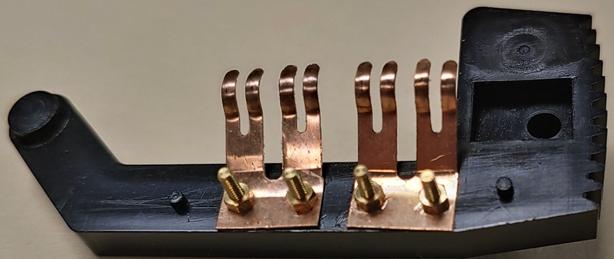
One method that has been shown to fix the problem permanently is to drill holes in the existing arm at the four locations where the heat staked rivets were, then use 00-90 screws and nuts to fasten the contacts back on. Use a #56 drill bit and 3/16” long (preferably) hex head machine screws. We find it best to insert the screws from the underside of the arm and let them stick out the topside through the contact(s). Then thread a nut down onto the contact. You will have to hold the head of the fastener up inside the arm with a pair of needle nose plyers. We recommend drilling only one hole to start and get the contact fastened on with one screw, then carefully straighten the contact into the correct position and drill the second hole through the hole in the contact. Then place and fasten the second screw. A tiny drop of Loctite can be added to the screw/nut threads. Or a drop of lacquer can be added after the nut is tight. After tightening, you should clip the excess screw thread off with diagonal cutters to prevent interference.
Once in awhile, one or both of the contacts somehow find their way out of the machine after they break off. We will get you some new ones. Contact us at: Support@Circuitron.com
Scroll down to see photo. |


|
Photo of TORTOISE™ Arm with screws added to secure contacts—before adjusting and clipping off the excess thread. |